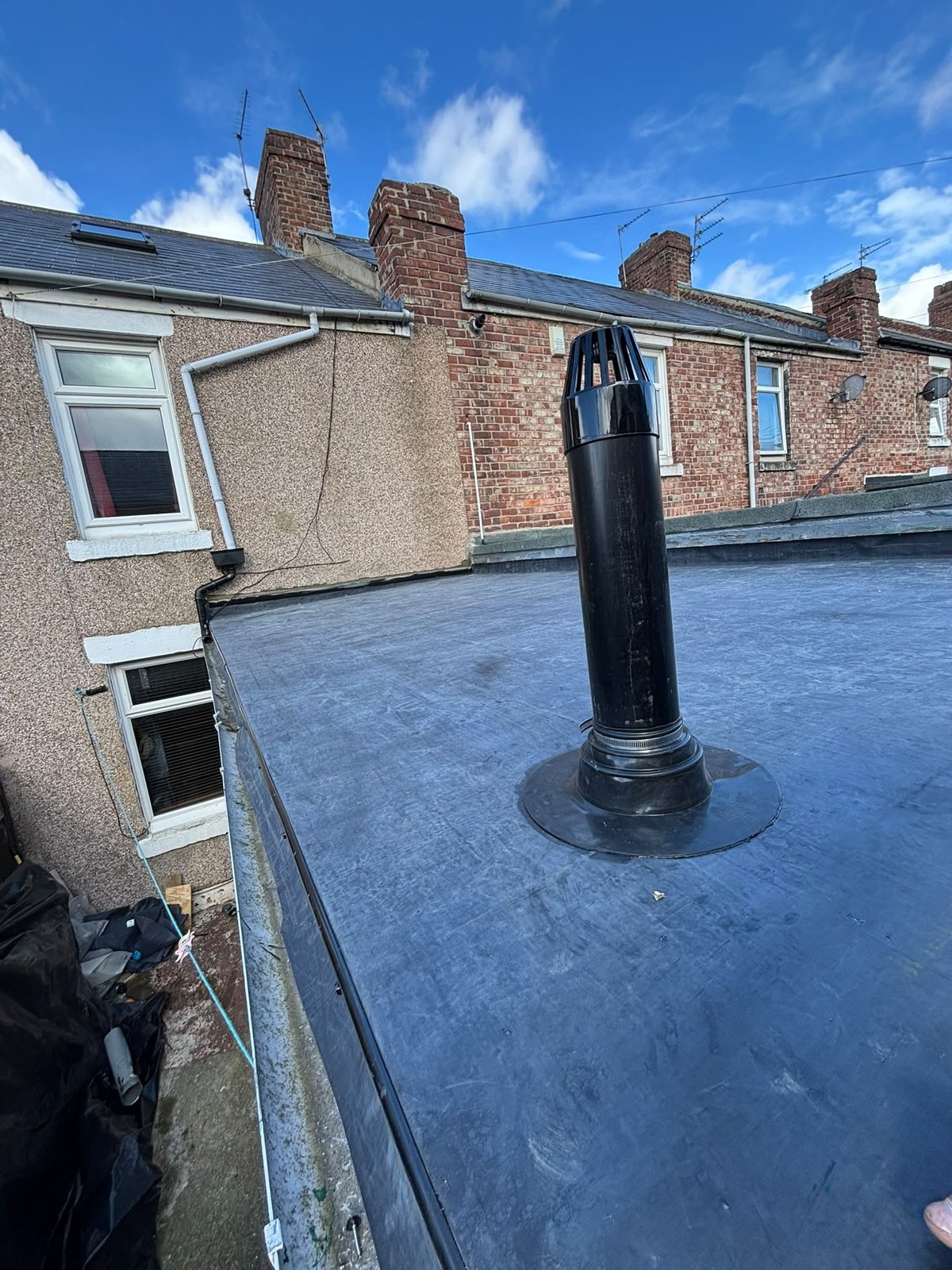
My garage roof leaks. Can it be patched?
Sometimes, and it is always worth asking. A covering with a single split, a lifted lap or a failed upstand on an otherwise sound deck can be repaired for a fraction of the cost of re-covering. What cannot be patched sensibly is a covering that has gone brittle across the whole area, or a deck that is soft underfoot, because a patch on those is buying a few months. Callum will get up, press on it, and tell you which one you have.
How long does a flat roof last?
It depends far more on how it was laid than on what it was laid in. A covering put down on a sound, dry, properly falling deck with the upstands taken high enough and the outlets sealed in will run for a long time. The same material laid over a damp deck, with a mean upstand and a blocked outlet, will be leaking in a couple of winters. Preparation and detailing are where the life of a flat roof actually comes from.
Why does water sit on my flat roof?
Because the falls are not doing their job, the outlet is blocked, or the deck has sagged. Ponding is not automatically a leak, but standing water accelerates the ageing of any covering and finds every weakness in it, so it is worth sorting rather than living with. Sometimes the answer is clearing an outlet, and sometimes it is building the falls back up when the roof is re-covered.
Do you cover dormers and extension roofs?
Yes. Dormer tops and cheeks, rear extension roofs, bay roofs and porches are all normal flat roofing work. The junction where a flat roof meets a wall or a pitched roof is the usual failure point on these, so the abutment detail and the flashing above it get as much attention as the flat area itself.
Will you have to take the old covering off?
Usually yes, and it is the right thing to do. Laying a new covering over an old one hides whatever is wrong with the deck, adds weight and gives water a layer to travel in unseen. There are situations where an overlay is a reasonable, cheaper option on a sound roof and it will be offered honestly as one, but it is not the default.
Can you do it in winter?
Flat roofing is weather dependent, more so than pitched work, because most coverings need a dry deck and a workable temperature to bond properly. In a North East winter that means picking the days rather than the week. If the weather will not allow a proper job, the roof is made watertight temporarily and the permanent work is done when it can be done right, which is better than a covering laid onto a wet deck in January.